At a glance: What is RGB MiniLED?
/n
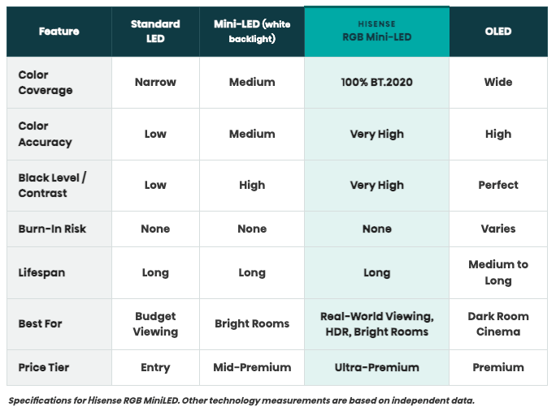
RGB MiniLED (also written as RGB Mini LED) is a TV display technology that uses separate red, green, and blue LEDs in the backlight to produce color more directly. Traditional MiniLED TVs generally use a single-color backlight and rely on additional layers within the display to create red, green, and blue. By generating those colors at the light source, RGB MiniLED can produce a wider range of colors with greater accuracy and efficiency.
/n
How does RGB MiniLED work?
/n
Traditional LED and MiniLED TVs use a backlight to create the light that ultimately becomes the picture on your screen. That backlight typically starts with white or blue LED light, which then gets filtered through various layers to separate that light into the red, green, and blue needed to create the colors that you see on your screen.
/n
RGB MiniLED changes where that color begins. The backlight itself contains separate red, green and blue LEDs that can be controlled in different combinations depending on what the picture requires. If an area of an image needs red, the backlight can produce red light directly in that area. Yellow can be created by combining red and green, while cyan can be produced by combining green and blue.
/n
The LCD panel still plays an important role in shaping the final image, so the backlight and panel have to work together continuously. The TV’s processor analyzes the image and coordinates the color and brightness produced by the RGB backlight with the information displayed by the LCD panel.
/n
How is RGB MiniLED different from traditional MiniLED?
/n
Traditional MiniLED and RGB MiniLED are both LCD television technologies that use many small LEDs within a backlight, but they control color differently. Traditional MiniLED primarily uses its backlight to control the amount of light reaching different areas of the screen. Color is then created through additional layers within the display.
/n
RGB MiniLED adds color control to the backlight itself. Separate red, green and blue light sources can be adjusted along with brightness, allowing the TV to control both the amount and color of light produced behind different parts of the image. In other words, traditional MiniLED primarily controls light at the backlight level, while RGB MiniLED adds direct control over light and color.
/n
The RGB MiniLED label alone does not guarantee that every RGB TV will perform the same way. Picture quality still depends on how effectively the manufacturer coordinates the RGB light sources with local dimming, the LCD panel and picture processing.
/n
What are the benefits of RGB MiniLED?
/n
Producing red, green and blue light directly within the backlight gives RGB MiniLED greater control over the light and color used to build an image. That can translate into a wider range of colors, more accurate color reproduction, stronger color at high brightness and more precise control in difficult high-contrast scenes.
/n
Because the backlight begins with the colors the picture needs, RGB MiniLED can also use a more direct path to create those colors than a conventional single-color backlight. This can reduce light lost through the display’s color-conversion process, improving efficiency while helping the TV maintain bright, vivid color.
/n
One of the clearest ways to measure that benefit is color gamut, which describes the range of colors a TV can reproduce. RGB MiniLED can expand that range because red, green and blue are generated directly within the backlight rather than being derived entirely from a single-color light source. That becomes especially important in highly saturated colors such as deep reds, greens, teals and violets.
/n
Hisense’s 2026 UR9 and UR8 Series RGB MiniLED TVs can achieve up to 100% BT.2020 color coverage, meaning they can reproduce the full color range defined by the BT.2020 standard. Hisense also uses third-party validation, including Pantone® Validated color accuracy and TÜV Rheinland certification, to support the technology’s color-performance claims.
/n
How does RGB MiniLED maintain color at high brightness?
/n
TVs often need to reproduce intense color and intense brightness at the same time. A bright red sports car in a sunny landscape, for example, requires the TV to reproduce intense red paint, blue sky, green grass, bright reflections and dozens of shades in between without those colors becoming washed out as brightness increases.
/n
Because RGB MiniLED controls the color of the backlight itself, it can produce strongly colored light behind those areas rather than relying on a conventional backlight to create brightness first and color later. This can help saturated colors remain vivid at high brightness, which is particularly important for HDR content.
/n
Can RGB MiniLED reduce blooming?
/n
RGB MiniLED can help reduce the appearance of blooming by controlling the color as well as the brightness of the backlight. Blooming is the visible halo of light that can sometimes appear around a bright object against a dark background. Traditional local dimming systems primarily manage luminance, or how bright each backlight zone becomes, so light from a bright zone can sometimes spill into surrounding dark areas.
/n
RGB MiniLED adds another layer of control because the backlight is managing color and luminance together. A zone behind a bright red object, for example, can produce red light rather than relying on a conventional single-color backlight. That can make any remaining light around the object closer in color to the object itself instead of appearing as a white or gray halo.
/n
The challenge is that this requires very precise coordination. Highly saturated colors, fast motion and fine white details inside colored areas can all make blooming and color control more complex. How well an RGB MiniLED TV handles those scenes ultimately depends on the way its backlight architecture, local dimming, optical design and picture-processing algorithms work together.
/n
Why is processing so important for RGB MiniLED?
/n
Processing is especially important for RGB MiniLED because the TV has to manage color and brightness together in real time. Traditional local dimming is primarily focused on luminance, while RGB MiniLED adds color to that equation, requiring the TV to continuously determine both how bright and what color the backlight should be across different areas of every frame.
/n
That becomes especially complex with highly saturated colors, fast motion or fine details where bright white textures sit inside colored areas. The television has to balance color, luminance, motion and local dimming at the same time without one adjustment negatively affecting another.
/n
For Hisense, this is where the Hi-View AI Engine RGB and picture-quality algorithms become particularly important. The processor coordinates the RGB light sources with the LCD panel in real time, helping the system maintain accurate color and brightness as the content changes. That is also why two TVs can use the same fundamental RGB backlight approach and still produce different results: the hardware matters, but so does how effectively the television controls it.
/n